Have an achievable goal. That will be your priority. Any other sidetracks are promises that can be achieved but should not be detrimental to the main goal's deadline.
-
Deadline is a promise to accomplish the said main goal at predetermined time. Many stakeholders would be expecting the main goal to be completed so that the downline processes will not be disrupted.
-
Once the main goal is achieved (or unachieved), proper closure should be implemented, e.g. writing of reports and future directions.
-
Once a main goal is completed, any discoveries along the process can be noted and pursued in the next project.
-
Hence prioritizing helps to ensure goals are achieved systematically and timely. If sidetracks are "really" promising, an alternative would be to delegate duties or collaborate. Whatever decisions should revolve around completing the main goal within deadlines.
Showing posts with label Information. Show all posts
Showing posts with label Information. Show all posts
Wednesday, July 6, 2016
Prioritize

Saturday, June 11, 2016
Aims & Objectives
Briefly, aims are what we want to achieve. Objectives are how (approach) we are going to achieve those aims.
-
Characteristics of aims and objectives are similar, such that they should be:
Concise
Interrelated
Achievable
Sound
Unambiguous
Friday, March 27, 2015
Mnemonic for nucleotide nomenclature
This information is procured from "Nucleotide Nomenclature and Symbol" (In Biological Sciences).
 |
| Mnemonic for nucleotide nomenclature and symbol. The letters cap and underlined are the symbols. E.g. W represents Adenine and Thymine (or W = A or T), K represents Guanine and Thymine (K = G or T). |
Thursday, March 5, 2015
Estimate the molecular/formula weight of DNA based on its length in base pair (bp)
This is just an estimation, i.e. 650.
-
How to calculate Molarity and Number of DNA molecules
-
-
-
-
This is for my own reference.
-
How to calculate Molarity and Number of DNA molecules
- Calculate the molecular weight of DNA molecule
-
- Calculate the Molarity of DNA solution
-
- Calculate the number of DNA molecules in a volume of DNA solution
-
- Calculate the number of DNA molecules based on mass
-
This is for my own reference.
Monday, February 16, 2015
Prevent autoclave water from seeping into pipette tip boxes
When I want to autoclave pipette tip boxes, I would place these boxes at higher level during autoclave. Placing these boxes (or other materials) near to the perforated platform just above the autoclave water would invite the "dirty" autoclave water (sometimes we tend to change the water once every two days or more) from seeping into the tip boxes. The brownish (probably due to spilt media) water will seep into the boxes and when dried, the tips will have a yellowish to brown stain covering them later.
The dirty water might contain impurities that will inhibit sensitive reactions or worst, contaminate stock solutions, enzymes, and expensive reagents.
Not all labs would use commercially packed filtered tips and we do use sterilized tips for dispensing expensive reagents. It is very important to properly autoclave tip boxes so that no contamination from the autoclave water will occur.
I had my fair share of dirty tips due to the above type of autoclave machine.
Just to share.
 |
| When the tip boxes are placed neat to the perforate platform just above the autoclave water, then during the autoclave, the dirty water will thrash inside the autoclave and some of the water will seep into the tip boxes via cracks. That will contaminate these boxes. |
The dirty water might contain impurities that will inhibit sensitive reactions or worst, contaminate stock solutions, enzymes, and expensive reagents.
Not all labs would use commercially packed filtered tips and we do use sterilized tips for dispensing expensive reagents. It is very important to properly autoclave tip boxes so that no contamination from the autoclave water will occur.
I had my fair share of dirty tips due to the above type of autoclave machine.
Just to share.
Wednesday, February 11, 2015
Inspiring story about Robert Langer
This is a story about Robert Langer, "Engineer of Change" by TheScientist.
At times, it's so challenging to stay in Science. If you don't publish, it's difficult to stay on to do research, as you might get penalized during job application or interview (for not having enough publications). I'm struggling with that now and it's demoralizing to get no rejection (no news).
I have to remind myself that it's all about having the right attitude (to get through the day). If indeed there is genuine love and passion for Science and the believe that our contribution will benefit mankind, environment and future, I guess going at different callings (opportunity that came knocking during the downs) will eventually lead us back to Science. For now, I'm applying for more options than just relying on research.
This article helped
Friday, October 31, 2014
Protein concentration, membrane based, Molecular Weight Cutoff aka Nominal Molecular Weight Limit
Protein concentrator based on membrane and centrifugation works by removing biomolecules at determined molecular size/weight. For example, a membrane-based protein concentrator such as Centriprep Centrifugal Filter Unit with Ultracel-50 membrane (Merck Millipore cat# 4311) has a protein cutoff point at 50 kDa. The term used can be Molecular Weight Cutoff (MWCO; refer to Wikipedia) or Nominal Molecular Weight Limit (NMWL) but they mean similar thing, that proteins at or above 50 kDa is trapped/concentrated whereas molecules at <50 be="" br="" kda="" removed.="" will="">
How to go about hard binding thesis in NTU Singapore
At last, finished my PhD defense and on the way to hard bind my thesis. Although NTU Library no longer collect hard copy theses, NTU schools still collect them for archiving. So, I need to prepare these hard copies.
To have my thesis bound in hard cover, I had to do it at the NTU library printing station (Campus Supplies Pte Ltd). The printing station is equipped with plethora of printers, scanners, and photocopiers. The payment method can be made via Ezlink. The shop was well equipped to cater to students, staffs and lecturers' needs.
One thing I didn't really fancy in the place. Not all staff is friendly. They are not rude, but they aren't welcoming and friendly. What a shame. The whole affair was very terse and impatient. Fortunately, not all the staff are like that. I guess their mundane work and the lack of friendlier and conducive environment sort of transformed them into zombie-like.
Anyway, the cost for hard binding a thesis is SGD 18. For two theses, it costs SGD 34. There is a submission date and a collection date (which is a week after submission). The theses are sent to a binder and collected in a week's time.
Alternatively, students can also contact another shop providing the above service, e.g. Ultra Supplies at Queensway. I have not contacted them because the place is far from NTU and probably nearer to students staying near NUS.
Contact
Ultra Supplies
No. 1 Queensway Office, #03-38/39
Main Service Counters, #03-37/45
Queensway Shopping Centre
Singapore 149053
Tel: 64796074
Fax: 64750845
For friendly assistance, call
Philip at 90214846
Kevin at 90216062
Campus Supplies Pte Ltd
Lee Wee Nam Library NTU
Tel: 67935980
Email: campusntu@campus-supplies.com
Mailing address:
Kent Ridge P. O. Box 1053
S911102
If given the chance, I would like to try dealing with Ultra Supplies and compare the service standard with that of Campus Supplies Pte Ltd. This is considering that the business card of the former included the description "for friendly assistance, call". That's a strange way to assure customers of friendly service. I would have expected all staffs should be friendly rather than assigning certain staffs as friendly...
Strange thought.
To have my thesis bound in hard cover, I had to do it at the NTU library printing station (Campus Supplies Pte Ltd). The printing station is equipped with plethora of printers, scanners, and photocopiers. The payment method can be made via Ezlink. The shop was well equipped to cater to students, staffs and lecturers' needs.
One thing I didn't really fancy in the place. Not all staff is friendly. They are not rude, but they aren't welcoming and friendly. What a shame. The whole affair was very terse and impatient. Fortunately, not all the staff are like that. I guess their mundane work and the lack of friendlier and conducive environment sort of transformed them into zombie-like.
Anyway, the cost for hard binding a thesis is SGD 18. For two theses, it costs SGD 34. There is a submission date and a collection date (which is a week after submission). The theses are sent to a binder and collected in a week's time.
Alternatively, students can also contact another shop providing the above service, e.g. Ultra Supplies at Queensway. I have not contacted them because the place is far from NTU and probably nearer to students staying near NUS.
Contact
Ultra Supplies
No. 1 Queensway Office, #03-38/39
Main Service Counters, #03-37/45
Queensway Shopping Centre
Singapore 149053
Tel: 64796074
Fax: 64750845
For friendly assistance, call
Philip at 90214846
Kevin at 90216062
Campus Supplies Pte Ltd
Lee Wee Nam Library NTU
Tel: 67935980
Email: campusntu@campus-supplies.com
Mailing address:
Kent Ridge P. O. Box 1053
S911102
If given the chance, I would like to try dealing with Ultra Supplies and compare the service standard with that of Campus Supplies Pte Ltd. This is considering that the business card of the former included the description "for friendly assistance, call". That's a strange way to assure customers of friendly service. I would have expected all staffs should be friendly rather than assigning certain staffs as friendly...
Strange thought.
Tuesday, September 16, 2014
Ligation independent cloning
I was following Nick Oswald's approach for ligation independent cloning (LIC) until I realized that his method can't really work. The reference to the original work that he linked to was okay and should be adhered to. I think Nick's method failed because he was thinking of adding a start codon and several bases just to bring up the number of bases to at least 15 bases of "overlap" (the N-term amino acid MRRGAP). However, when you studied the bases that he used in the example (I'm guessing that the method he showed was just a proof-of-concept, without any empirical value), one big problem arises.
The %GC content is extremely high (at 78.8% GC). This will proof to be a downfall because whenever users want to design primers that incorporate termini that is complementary to the LIC sequence, they will realize that the homo-dimerization will be a big problem (homodimer delta G = -22.78 kcal/mole). That is just for the forward primer with 5' extension of TGCGGCGTGGCGCGCCGCAA. This alone is already a big headache to many people. Another major problem is that there is a hairpin problem. The formation of hairpin is very likely! Imagine what will happen if more gene-specific bases are added to the bases already prone to hairpin formation...

I don't understand why Nick's approach requires incorporation of start codon. If LIC cloning is really versatile, addition of ATG to the sequence after the LIC complementary termini should be a breeze.
I have made the vector with the LIC sequence, but I'm afraid I'm stuck with the primer design and PCR steps. I wished I had studied Nick's method in detail before embarking on the DNA vector construction. This entry is just to warn others to read Nick's approach with caveat. My advise is that if you want to incorporate LIC sequence, refer to this paper.
The %GC content is extremely high (at 78.8% GC). This will proof to be a downfall because whenever users want to design primers that incorporate termini that is complementary to the LIC sequence, they will realize that the homo-dimerization will be a big problem (homodimer delta G = -22.78 kcal/mole). That is just for the forward primer with 5' extension of TGCGGCGTGGCGCGCCGCAA. This alone is already a big headache to many people. Another major problem is that there is a hairpin problem. The formation of hairpin is very likely! Imagine what will happen if more gene-specific bases are added to the bases already prone to hairpin formation...
I don't understand why Nick's approach requires incorporation of start codon. If LIC cloning is really versatile, addition of ATG to the sequence after the LIC complementary termini should be a breeze.
I have made the vector with the LIC sequence, but I'm afraid I'm stuck with the primer design and PCR steps. I wished I had studied Nick's method in detail before embarking on the DNA vector construction. This entry is just to warn others to read Nick's approach with caveat. My advise is that if you want to incorporate LIC sequence, refer to this paper.
Friday, August 22, 2014
Definition my friend, without definition I can't understand you
In written work, please provide sufficient (if not redundant) amount of definition/explanation of terms used in the writing. If a writer fails to do so, it will be very difficult for readers to understand what you are trying to say.
In a conversation, at least when the listener can't understand a term/expression introduced into the speech, he/she can still stop the speaker on his/her track to ask about the ambiguous or foreign term (or expression) just used.
So, when someone is talking about "input tax", "residual supplies, claim, and "De Minimis Rule", a Science person like me only hear tax input, what supply leftover, claim, minimal rule, what? It make no sense.
In a conversation, at least when the listener can't understand a term/expression introduced into the speech, he/she can still stop the speaker on his/her track to ask about the ambiguous or foreign term (or expression) just used.
So, when someone is talking about "input tax", "residual supplies, claim, and "De Minimis Rule", a Science person like me only hear tax input, what supply leftover, claim, minimal rule, what? It make no sense.
Thursday, August 21, 2014
How to manually merge two channels using Zeiss Axiovision
I forgets how to do this and thus, having a blog to refer to will be useful. This is a manual method to merge images taken using Axiovision. There is an automatic method (multidimensional) to acquire and merge the images, but I will not cover it here.
First, acquire multiple images with different channel, e.g. Bright field (BF), Green, Red, Blue etc. Then go to the first image and click on Processing in the menu bar, scroll down and click on Add Channel. A popup will show the first image and there is a box to check for [preview].
On the bottom, there is input 1 to input 3 (if you want to merge three images). Click ok and the software will generate the merged image. In order to view the different channels, and merge image in a screen, click on the "gallery view" tab at the bottom of the image. You can individually select a channel and adjust the brightness. There could be other adjustment to image you can do.
That's it.
First, acquire multiple images with different channel, e.g. Bright field (BF), Green, Red, Blue etc. Then go to the first image and click on Processing in the menu bar, scroll down and click on Add Channel. A popup will show the first image and there is a box to check for [preview].
On the bottom, there is input 1 to input 3 (if you want to merge three images). Click ok and the software will generate the merged image. In order to view the different channels, and merge image in a screen, click on the "gallery view" tab at the bottom of the image. You can individually select a channel and adjust the brightness. There could be other adjustment to image you can do.
That's it.
Monday, July 28, 2014
Cluster of differentiation (CD) molecules; nomenclature and list 2014
The list of CD designation, nomenclature, and others can be accessed in uniprot (www.uniprot.org/docs/cdlist.txt).
Friday, June 27, 2014
How to elute delivered DNA on Whatman paper
Usually, we deliver DNA (1 ug) dried on a Whatman paper and the spot is circled with a pencil to mark the spot. That is the most convenient way to post/mail DNA abroad. It's better and more cost-saving than shipping DNA solution in a tube.
Once the DNA reaches the lab, we would cut out the spot demarcated by pencil and place it in a purification column and elute it with TE buffer. However, a purification column costs sgd 1.70 per item (or lesser now).
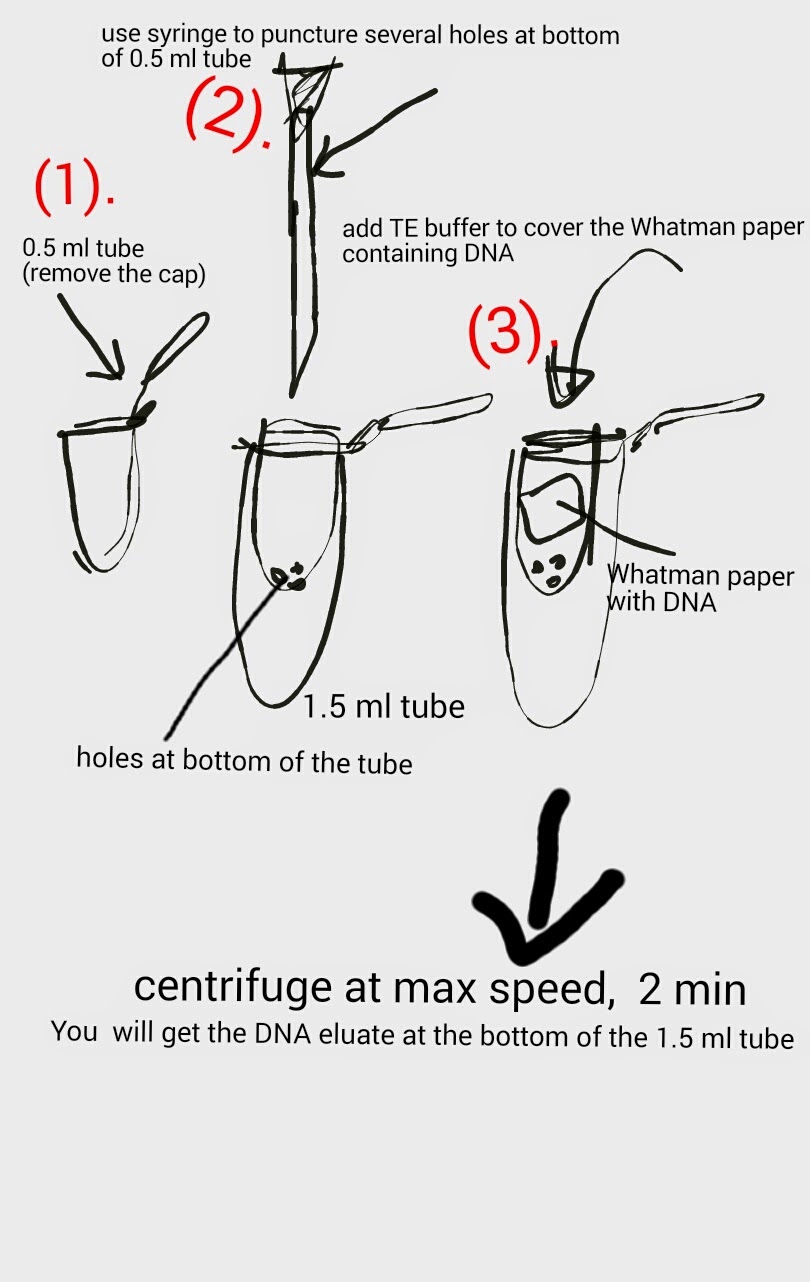
Another cheaper way to elute the DNA is by using a 0.5 ml tube (with the cap removed) and stack it into a 1.5 ml tube. Then by means of a syringe, the bottom of the 0.5 ml tube is perforated by repeated jabbing. Next, the cut-out DNA on paper is added into the 0.5 ml tube and sufficient TE buffer (e.g. 30 ml) is added to soak the cut-out piece. The assembly is the spun at max speed for 1 to 2 min to elute the DNA solution into the 1.5 ml tube. See figure for reference.
Thursday, June 19, 2014
Mnemonic - RNA pol II holoenzyme (my ref)
There are total of six general transcription factors (complexes):
TFIIA (Assist) TFIID to (Dock) to DNA. TFIIB (Binds) to TFIID to recruit RNA pol II. TFIIF (Fidelity) bound to RNA pol II prevents unspecific docking. TFIIE (Elongation) and TFIIH (Helicase) are recruited to docked RNA pol II and prepare from initiation to elongation phase.
TFIIA (Assist) TFIID to (Dock) to DNA. TFIIB (Binds) to TFIID to recruit RNA pol II. TFIIF (Fidelity) bound to RNA pol II prevents unspecific docking. TFIIE (Elongation) and TFIIH (Helicase) are recruited to docked RNA pol II and prepare from initiation to elongation phase.
Friday, June 13, 2014
"Good Samaritan corner" in the lab
Good Samaritan corner is needed in research lab. In my lab, common reagents/solutions were prepared by a single person and shared by many people. That took a toll on that person (especially when someone later complained about lack of solutions that affected experiments) and since then, there was no longer common reagents/solutions and everyone was supposed to prepare his/her own solutions.
I'm planning to assign a corner (or other places) in the lab "Good Samaritan corner" where we can volunteer to prepare solution without any expectation of its availability. If the solution is unavailable, no one should should, "solution A is empty!". The corner will be "you reap what you sow", in which the availability of common solutions is a shared volunteerism.
I'm planning to assign a corner (or other places) in the lab "Good Samaritan corner" where we can volunteer to prepare solution without any expectation of its availability. If the solution is unavailable, no one should should, "solution A is empty!". The corner will be "you reap what you sow", in which the availability of common solutions is a shared volunteerism.
Sunday, May 11, 2014
I like this advert, " The FLoid® Cell Imaging Station frees students tofocus on cell biology rather than instrumentoperation"
How true. If only instrument or software platforms can be more friendly to end users that we needn't spend too much time dealing with operation manual and instead go straight down to business of answers.
Thursday, March 20, 2014
Items for zebrafish injection
Capillary tube ( www.wpi-europe.com/products/glass/patch-clamp-glass-capillaries.aspx).
Saturday, February 22, 2014
Lab cleanliness without broom and dust
Labs are normally cleaned by contracted company and their employees use different methods to remove dirt from the floor. The worst method I've seen so far is by using broom to sweep up the dirt. The smaller particles are prone to linger around the air and subsequently land onto benches, bottles, and opened solutions. If you are plating on the same day the floor is swept, you will realize that the plates will get contaminated with fungi the next day (if you are lucky). That's how bad sweeping in the lab is.
The best way to prevent unsettling dust and contaminating the air in the lab is to use electrostatic fabric that will attract dusts and which can be subsequently disposed of.
Minimum information about an experiment (MIAxE)
Minimum information about an experiment (MIAxE) is a publication standard to provide necessary information for other labs to be able to replicate the published experiment.
There are currently two well-known MIAxEs: Minimum information about qPCR experiment (MIAQE or MIQE) and minimum information about microarray experiment (MIAME).
I hope there will be other standards to facilitate other labs to validate published results in respected journals. There shouldn't be excuses as to why some experiments can't be replicated. Although biological system is unpredictable (sometimes) or variable (most of the time), these variabilities wouldn't be to huge to prevent reproducibility of results.
Tuesday, May 21, 2013
There is a reason for not labeling properly in the lab
The first time I encountered such example would be in the common cold room. A stretch of LB antibiotic plates were placed nicely on a rack. At the bottom pasted a note reading, "use at your own risk, plates not labeled as it was meant to".
I scratched my head seeking for a reason. It never took long to figure out that the note was meant for other "unauthorized" users. It is also very likely that this person had been victim of pilfer for a long time and it reached the threshold of being calm to irritation for him/her.
Rule: "Use and let use" means to replace what you took from others and don't be a parasite.
I have adopted this approach (mislabel or unlabel) not long after. That started when I realized that the solutions I prepared not long ago were pilfered and I was left with insufficient amount at the most crucial time of the experiment. It is upsetting, no?
I scratched my head seeking for a reason. It never took long to figure out that the note was meant for other "unauthorized" users. It is also very likely that this person had been victim of pilfer for a long time and it reached the threshold of being calm to irritation for him/her.
Rule: "Use and let use" means to replace what you took from others and don't be a parasite.
I have adopted this approach (mislabel or unlabel) not long after. That started when I realized that the solutions I prepared not long ago were pilfered and I was left with insufficient amount at the most crucial time of the experiment. It is upsetting, no?
Subscribe to:
Posts (Atom)

 Posts
Posts

