I was following Nick Oswald's approach for ligation independent cloning (LIC) until I realized that his method can't really work. The reference to the original work that he linked to was okay and should be adhered to. I think Nick's method failed because he was thinking of adding a start codon and several bases just to bring up the number of bases to at least 15 bases of "overlap" (the N-term amino acid MRRGAP). However, when you studied the bases that he used in the example (I'm guessing that the method he showed was just a proof-of-concept, without any empirical value), one big problem arises.
The %GC content is extremely high (at 78.8% GC). This will proof to be a downfall because whenever users want to design primers that incorporate termini that is complementary to the LIC sequence, they will realize that the homo-dimerization will be a big problem (homodimer delta G = -22.78 kcal/mole). That is just for the forward primer with 5' extension of TGCGGCGTGGCGCGCCGCAA. This alone is already a big headache to many people. Another major problem is that there is a hairpin problem. The formation of hairpin is very likely! Imagine what will happen if more gene-specific bases are added to the bases already prone to hairpin formation...
I don't understand why Nick's approach requires incorporation of start codon. If LIC cloning is really versatile, addition of ATG to the sequence after the LIC complementary termini should be a breeze.
I have made the vector with the LIC sequence, but I'm afraid I'm stuck with the primer design and PCR steps. I wished I had studied Nick's method in detail before embarking on the DNA vector construction. This entry is just to warn others to read Nick's approach with caveat. My advise is that if you want to incorporate LIC sequence, refer to this paper.
Showing posts with label protocol. Show all posts
Tuesday, September 16, 2014
Thursday, August 21, 2014
How to manually merge two channels using Zeiss Axiovision
I forgets how to do this and thus, having a blog to refer to will be useful. This is a manual method to merge images taken using Axiovision. There is an automatic method (multidimensional) to acquire and merge the images, but I will not cover it here.
First, acquire multiple images with different channel, e.g. Bright field (BF), Green, Red, Blue etc. Then go to the first image and click on Processing in the menu bar, scroll down and click on Add Channel. A popup will show the first image and there is a box to check for [preview].
On the bottom, there is input 1 to input 3 (if you want to merge three images). Click ok and the software will generate the merged image. In order to view the different channels, and merge image in a screen, click on the "gallery view" tab at the bottom of the image. You can individually select a channel and adjust the brightness. There could be other adjustment to image you can do.
That's it.
First, acquire multiple images with different channel, e.g. Bright field (BF), Green, Red, Blue etc. Then go to the first image and click on Processing in the menu bar, scroll down and click on Add Channel. A popup will show the first image and there is a box to check for [preview].
On the bottom, there is input 1 to input 3 (if you want to merge three images). Click ok and the software will generate the merged image. In order to view the different channels, and merge image in a screen, click on the "gallery view" tab at the bottom of the image. You can individually select a channel and adjust the brightness. There could be other adjustment to image you can do.
That's it.
Friday, June 27, 2014
How to elute delivered DNA on Whatman paper
Usually, we deliver DNA (1 ug) dried on a Whatman paper and the spot is circled with a pencil to mark the spot. That is the most convenient way to post/mail DNA abroad. It's better and more cost-saving than shipping DNA solution in a tube.
Once the DNA reaches the lab, we would cut out the spot demarcated by pencil and place it in a purification column and elute it with TE buffer. However, a purification column costs sgd 1.70 per item (or lesser now).
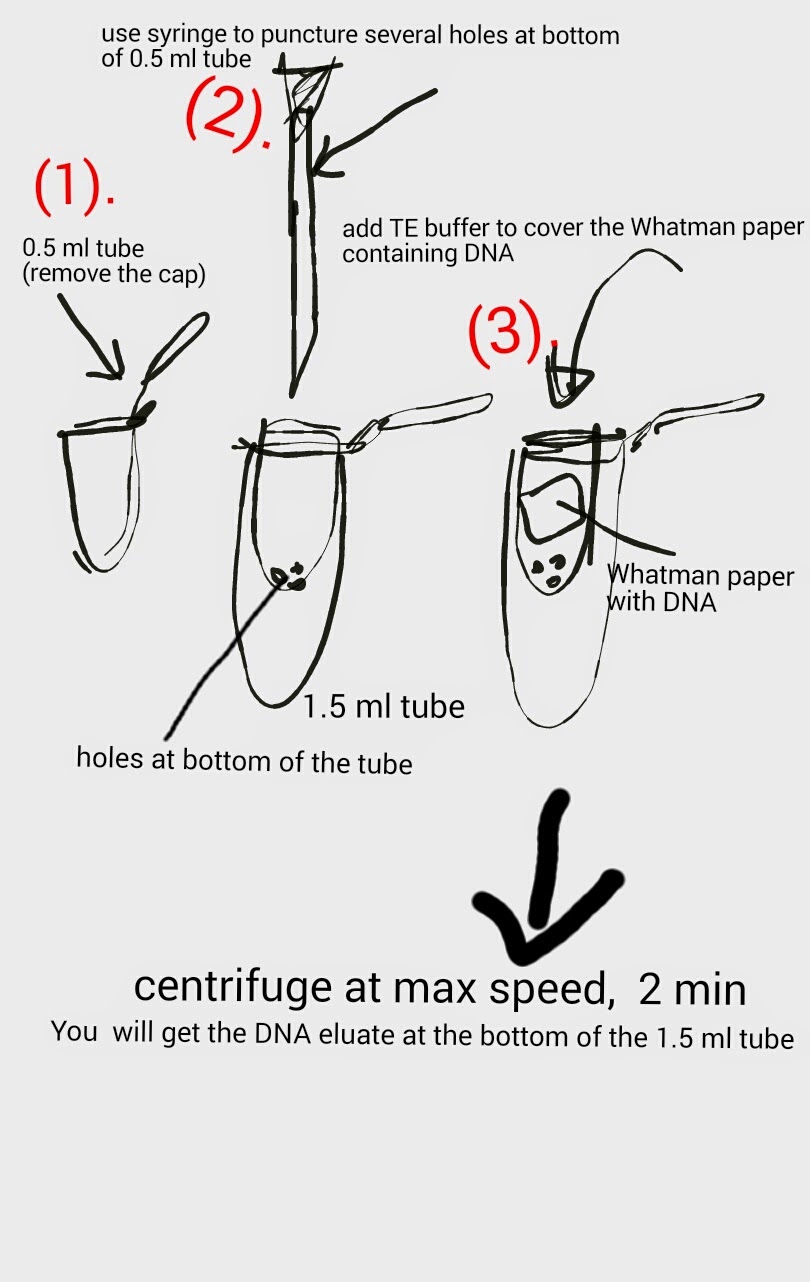
Another cheaper way to elute the DNA is by using a 0.5 ml tube (with the cap removed) and stack it into a 1.5 ml tube. Then by means of a syringe, the bottom of the 0.5 ml tube is perforated by repeated jabbing. Next, the cut-out DNA on paper is added into the 0.5 ml tube and sufficient TE buffer (e.g. 30 ml) is added to soak the cut-out piece. The assembly is the spun at max speed for 1 to 2 min to elute the DNA solution into the 1.5 ml tube. See figure for reference.
Saturday, February 22, 2014
Minimum information about an experiment (MIAxE)
Minimum information about an experiment (MIAxE) is a publication standard to provide necessary information for other labs to be able to replicate the published experiment.
There are currently two well-known MIAxEs: Minimum information about qPCR experiment (MIAQE or MIQE) and minimum information about microarray experiment (MIAME).
I hope there will be other standards to facilitate other labs to validate published results in respected journals. There shouldn't be excuses as to why some experiments can't be replicated. Although biological system is unpredictable (sometimes) or variable (most of the time), these variabilities wouldn't be to huge to prevent reproducibility of results.
Subscribe to:
Posts (Atom)