Showing posts with label diy. Show all posts

Wednesday, February 11, 2015

DIY Brine shrimp (or Artemia) hatchery

Introduction
Brine shrimp (or Artemia salina) is a crustacean used as a food source for fry and fish. In a zebrafish facility, brine shrimp is used as a intermittent feed for the fry and adults. Shrimp hatchlings at less than two days old contain yolky reserve rich in nutrients for fry and adult fish (feeding them artemia increases better egg production in females).

Materials
  • Brine shrimp eggs. Don't get those decapsulated eggs that will not hatch BUT used directly to feed fish instead. For bulk order, you can visit BrineShrimpDirect (I have not dealt with them so any question do contact them directly). In eBay, the cost is  about SGD 2.20 per 10 g of eggs. Normally, I will use 2 tbsp per 1 litre sea salt water and allow it to hatch overnight with aeration.

Brine shrimp eggs from eBay seller fishmanofrobertsbridge.

Sea salt from eBay seller timholliday.

  • Shrimp hatchery set. You can DIY by using a Coca Cola 2 liter bottle, aquarium tubing, and plastic hollow balloon sticks (see fig below).

 
DIY brine shrimp hatchery. Instead of having a nozzle at the bottom to drain out the hatched shrimp, I prefer using the balloon stick connected to tubing to siphon off the shrimps from the vessel. That way, I will not be collecting unhatched eggs settled to the bottom as I would by using the bottom outlet (in commercial setting). 

Once the unhatched eggs are settled to the bottom and the empty cyst floating at the surface, I would usually use the hollow stick/straw connected to tubing to siphon out the shrimp (indicated red). A muslin cloth is normally used to net the shrimp and added back to fish water (at a reduced salt concentration) before feeding.

Different stages of maturity of the brine shrimps. New hatchlings are preferred due to their high yolk content, whereas older shrimps might have loss some yolky storage. The unhatched eggs are shown here.


 For commercial hatchery, you can search for them from eBay. Just key in brine shrimp hatchery and you will get returns.

Notes
  • Hatching the eggs is good for maximum three days. After that, the shrimp will lose its yolk reserve and would also have lost their nutritious value. If you need to keep shrimp for more than three days, it is best to feed the brine shrimp in order to keep them alive.
  • Don't feed too much shrimp to your fish because this food is considered fatty. Feed the fish once per day and add in dry food for the other two feeding per day (total 3 feeding).
  • Fish will always be hungry. So, don't allow demand feeding because there will always be demand. Fish will die of obesity-related complications!
DIY material

Hollow balloon sticks (get white ones if preferred). Fig from www.balloonsandweights.com.


Muslin cloth or cloth coffee filter (you can get this from Aliexpress or shops)


Tuesday, September 16, 2014

Ligation independent cloning

I was following Nick Oswald's approach for ligation independent cloning (LIC) until I realized that his method can't really work. The reference to the original work that he linked to was okay and should be adhered to. I think Nick's method failed because he was thinking of adding a start codon and several bases just to bring up the number of bases to at least 15 bases of "overlap" (the N-term amino acid MRRGAP). However, when you studied the bases that he used in the example (I'm guessing that the method he showed was just a proof-of-concept, without any empirical value), one big problem arises.

The %GC content is extremely high (at 78.8% GC). This will proof to be a downfall because whenever users want to design primers that incorporate termini that is complementary to the LIC sequence, they will realize that the homo-dimerization will be a big problem (homodimer delta G = -22.78 kcal/mole). That is just for the forward primer with 5' extension of TGCGGCGTGGCGCGCCGCAA. This alone is already a big headache to many people. Another major problem is that there is a hairpin problem. The formation of hairpin is very likely! Imagine what will happen if more gene-specific bases are added to the bases already prone to hairpin formation...


I don't understand why Nick's approach requires incorporation of start codon. If LIC cloning is really versatile, addition of ATG to the sequence after the LIC complementary termini should be a breeze. 

I have made the vector with the LIC sequence, but I'm afraid I'm stuck with the primer design and PCR steps. I wished I had studied Nick's method in detail before embarking on the DNA vector construction. This entry is just to warn others to read Nick's approach with caveat. My advise is that if you want to incorporate LIC sequence, refer to this paper.

Friday, June 27, 2014

How to elute delivered DNA on Whatman paper

Usually,  we deliver DNA (1 ug) dried on a Whatman paper and the spot is circled with a pencil to mark the spot. That is the most convenient way to post/mail DNA abroad. It's better and more cost-saving than shipping DNA solution in a tube.
Once the DNA reaches the lab,  we would cut out the spot demarcated by pencil and place it in a purification column and elute it with TE buffer.  However,  a purification column costs sgd 1.70 per item (or lesser now).
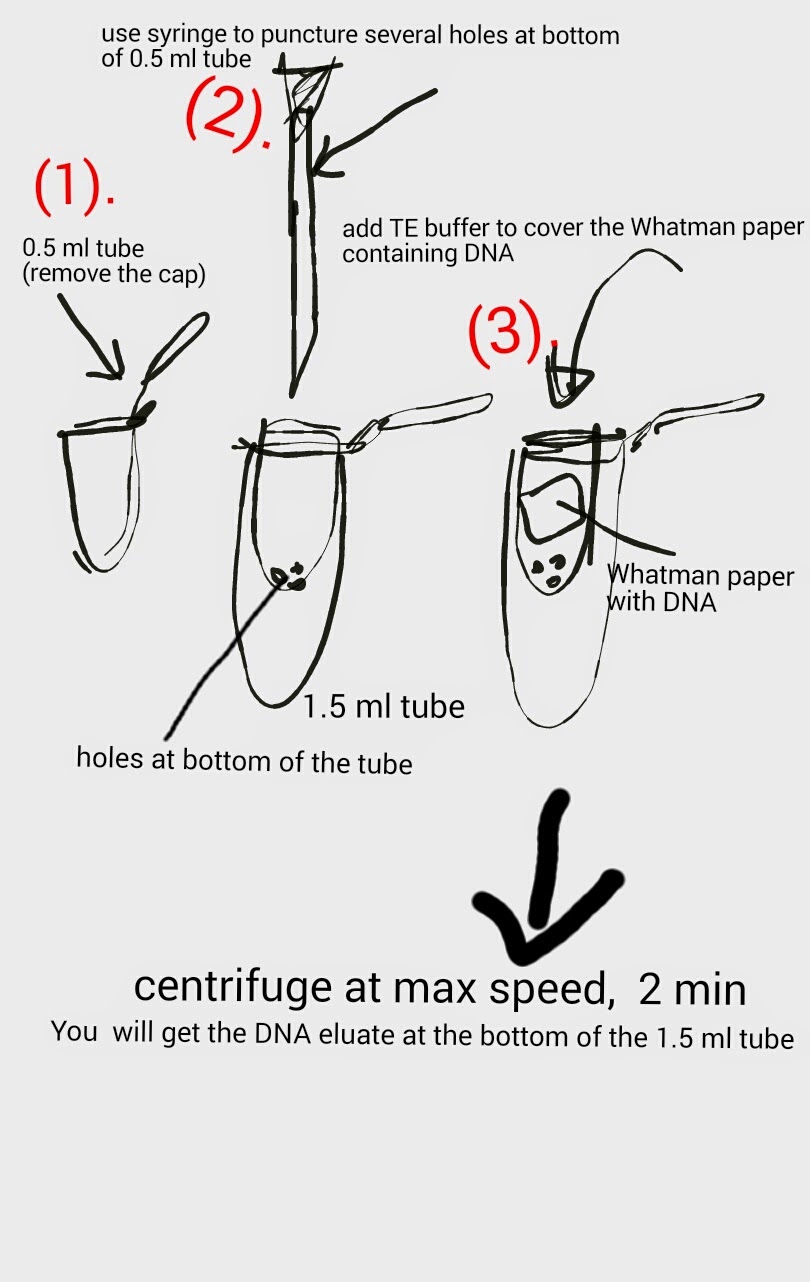
Another cheaper way to elute the DNA is by using a 0.5 ml tube (with the cap removed) and stack it into a 1.5 ml tube.  Then by means of a syringe,  the bottom of the 0.5 ml tube is perforated by repeated jabbing. Next,  the cut-out DNA on paper is added into the 0.5 ml tube and sufficient TE buffer (e.g. 30 ml) is added to soak the cut-out piece. The assembly is the spun at max speed for 1 to 2 min to elute the DNA solution into the 1.5 ml tube. See figure for reference.

Friday, June 13, 2014

"Good Samaritan corner" in the lab

Good Samaritan corner is needed in research lab. In my lab, common reagents/solutions were prepared by a single person and shared by many people. That took a toll on that person (especially when someone later complained about lack of solutions that affected experiments) and since then, there was no longer common reagents/solutions and everyone was supposed to prepare his/her own solutions.

I'm planning to assign a corner (or other places) in the lab "Good Samaritan corner" where we can volunteer to prepare solution without any expectation of its availability. If the solution is unavailable, no one should should, "solution A is empty!". The corner will be "you reap what you sow", in which the availability of common solutions is a shared volunteerism.